

About the World Map of The Brunch News
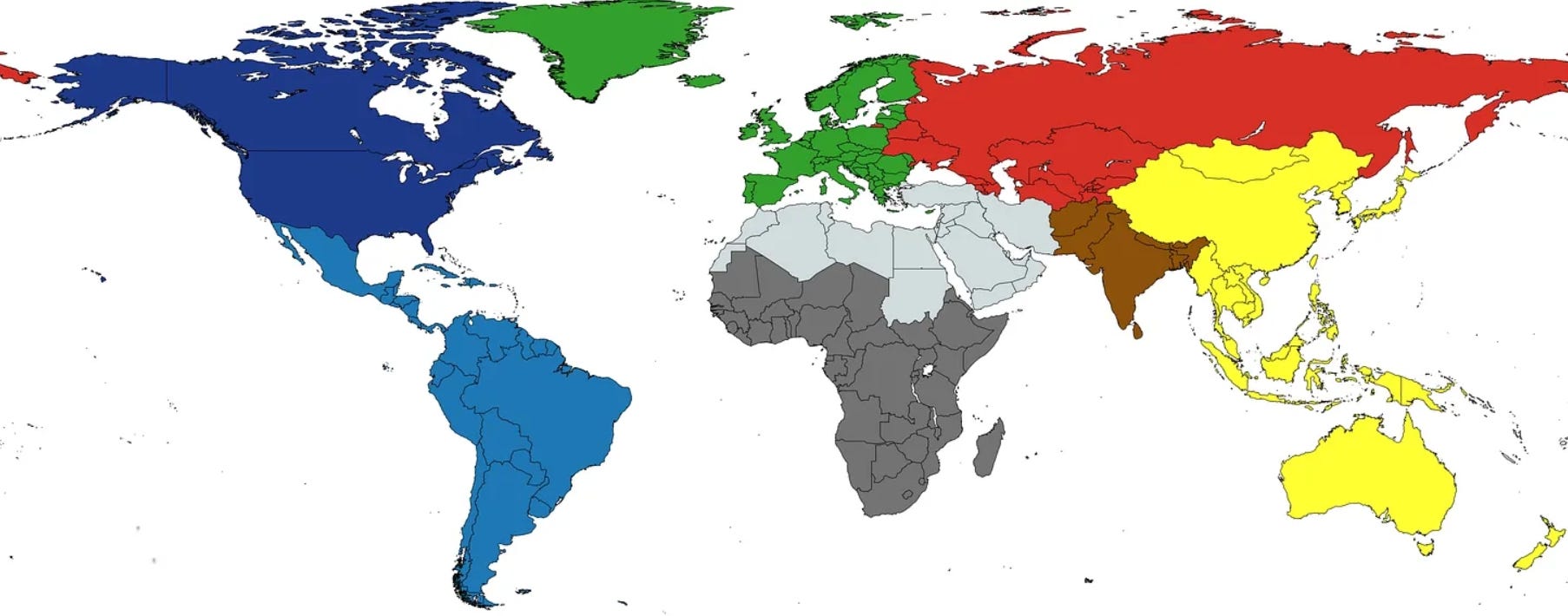
Most news outlets divide the world into a handful of familiar regions: Europe, Asia, Africa, the Americas. It’s clean, intuitive, and often misleading.
At The Brunch News, the world is not grouped by geography alone, but by something more useful for understanding events:
power, alignment, and behavior.
This is why you’ll find eight regions here instead of the usual six, or the even more reductive “three worlds.” The goal is not to simplify the map, but to make it more truthful to how the world actually works.
The Principle: Not Geography, but Gravity
Countries are grouped based on the gravitational pull of major power centers—economic, political, and strategic.
Some of these centers are obvious:
the United States
China
Russia
India
Others are looser but still coherent:
Europe
the Arab world
Latin America
Africa
Think of each region as an orbit, or a tribe of countries, not a continent.
Why Not the Classic 6 Regions?
The traditional model works well for textbooks, but poorly for reality.
For example:
“Asia” includes Japan, India, Saudi Arabia, and Indonesia, countries with little in common strategically
“North America” lumps together the US and Canada (reasonable), but says nothing about their global role
“Europe” often includes countries that are geographically European, but not aligned with Europe politically
In short:
Geography tells you where a country is.
This system tells you how it behaves.
The Eight Regions Explained
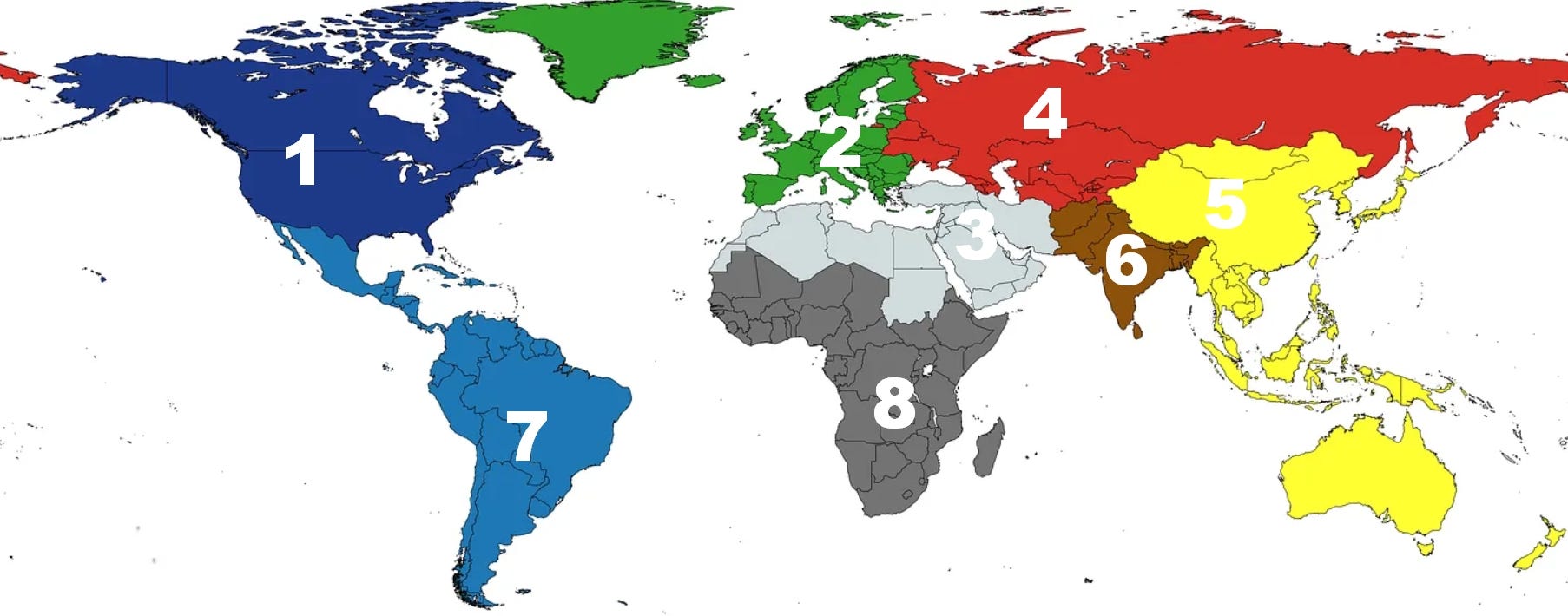
1. US & Canada
A tightly integrated bloc with shared economic systems, security structures, and global outlook. This is the core of the Western system.
2. Europe
A political and economic union (formal or informal) with shared institutions, norms, and strategic alignment and the non-EU neighbors.
3. Middle East & Arab World
Not just a region, but a civilizational and political space, shaped by shared language, religion, and interconnected conflicts.
4. Russia & Post-Soviet Sphere (Or “World”)
This is not about geography, but about historical and structural inheritance.
Countries like Belarus, Kazakhstan, or Armenia are not simply “European” or “Asian.” They exist within systems shaped by the Soviet past and, in many cases, by ongoing Russian influence.
This is also why:
Ukraine
Belarus
Georgia
are placed here.
Not because they “belong” to Russia, but because they remain, to different degrees, entangled in its gravitational field.
On Exceptions: Moldova and the Baltic States
Not all former Soviet republics fit neatly into this category.
Some share the same institutional past, but differ fundamentally in identity, direction, and long-term alignment.
Moldova
Moldova is a particular case.
The modern Moldovan state was formed by the detachment of territory from interwar Romania, and its population is predominantly Romanian in language, culture, and historical memory. In this sense, Moldova is not a civilizational extension of the Russian world, but rather a second Romanian state that developed under Soviet administration.
However, unlike the Baltic states, Moldova has not fully escaped the structural legacy of the Soviet system. Its institutions, economy, and political landscape remain partially shaped by that inheritance, and Russian influence—direct or indirect—has not entirely disappeared.
For this reason, Moldova occupies an intermediate position:
culturally aligned with Europe, but structurally not yet fully detached from the post-Soviet space.
The Baltic States
Estonia, Latvia, and Lithuania represent a different outcome.
Although they were part of the Soviet Union, they maintained a strong historical identity distinct from it, and after regaining independence they moved decisively toward Western institutions. Today, as members of the European Union and NATO, they are firmly integrated into the European system.
Their Soviet past remains part of their history, but it no longer defines their geopolitical or institutional alignment.
These distinctions highlight an important principle:
this classification reflects present realities, not permanent labels.
Countries can and do move between systems over time.
The Baltic states have already completed that transition.
Moldova may be in the process of doing so.
Ukraine’s trajectory remains contested and unresolved.
The map, therefore, is not fixed. It is a snapshot of a world in motion.
5. East Asia & Pacific
Centered around China, Japan, and Korea, this region includes Southeast Asia and extends to Australia and New Zealand.
Why include Australia and New Zealand here?
Because this is not about culture or language, it’s about strategic theater.
Australia operates within the Indo-Pacific system, tied to:
US-China competition
regional security dynamics
economic interdependence with Asia
Placing it in a vague “Anglosphere” that is more about the past than about the present would hide this reality.
6. South Asia
Anchored by India, this region includes Pakistan, Bangladesh, and neighboring states.
This is a distinct geopolitical system, with its own internal rivalries, economic patterns, and demographic weight.
It is not simply “Asia,” and it is not part of the Middle East.
7. Latin America & Caribbean
A region defined by shared history, language roots, and economic trajectories.
While diverse, these countries often move within similar political and economic cycles, distinct from North America.
8. Africa (excluding the North Africa, which is part of the Arab world)
Treated as a single block, not because it is uniform, but because it is systemically under-covered and structurally interconnected in global narratives.
This also allows space to surface stories that are often ignored in fragmented models.
A Living System
This taxonomy is not fixed forever.
Countries evolve, alliances shift and power moves.
Ukraine may one day fully integrate into Europe
Southeast Asia may become more cohesive
Africa may split into multiple distinct blocs
When that happens, the map will change.
Why This Matters
The goal of this system is simple:
to help you see the world more clearly, faster.
Each morning, instead of scanning a flat list of headlines, you’re looking at:
distinct systems
competing narratives
different centers of gravity
Over time, patterns emerge.
And once you start seeing those patterns, the news stops feeling random.
Final Thought
This is not the map of the world.
It’s a map that works, for understanding power, conflict, and change.
And like any good map, its value is not in being perfect, but in helping you navigate.